
Airconsults
A scenario and flight-economics simulator I built for an aviation advisory client, so investors could change the assumptions and watch the returns move.
01 / The brief
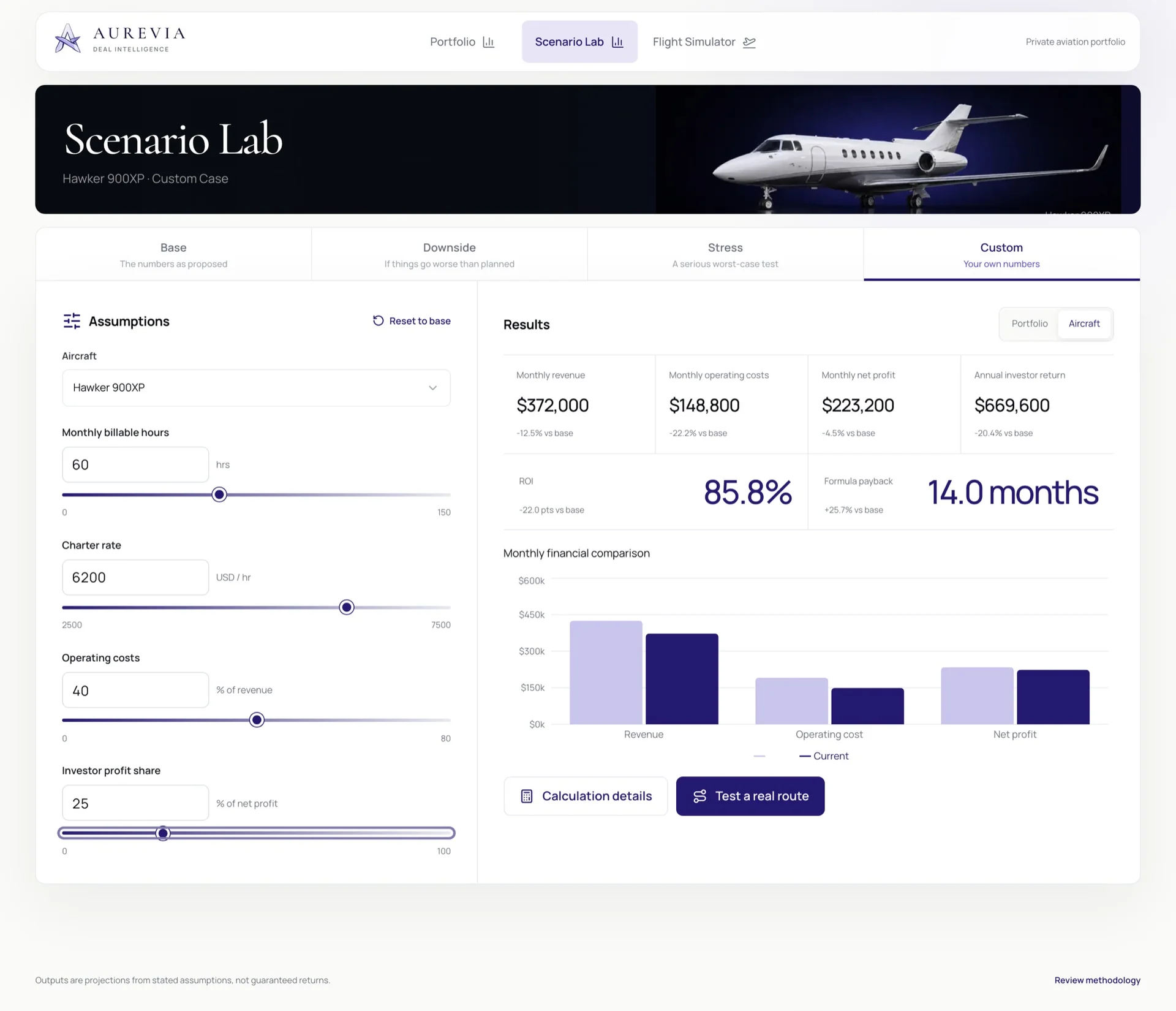
The investment case lived in a static PDF, and investors can challenge any fixed projection. The advisor needed a way to answer "what if flight hours are lower, or costs higher?" live, in the room, without rebuilding a spreadsheet each time.
02 / What I built
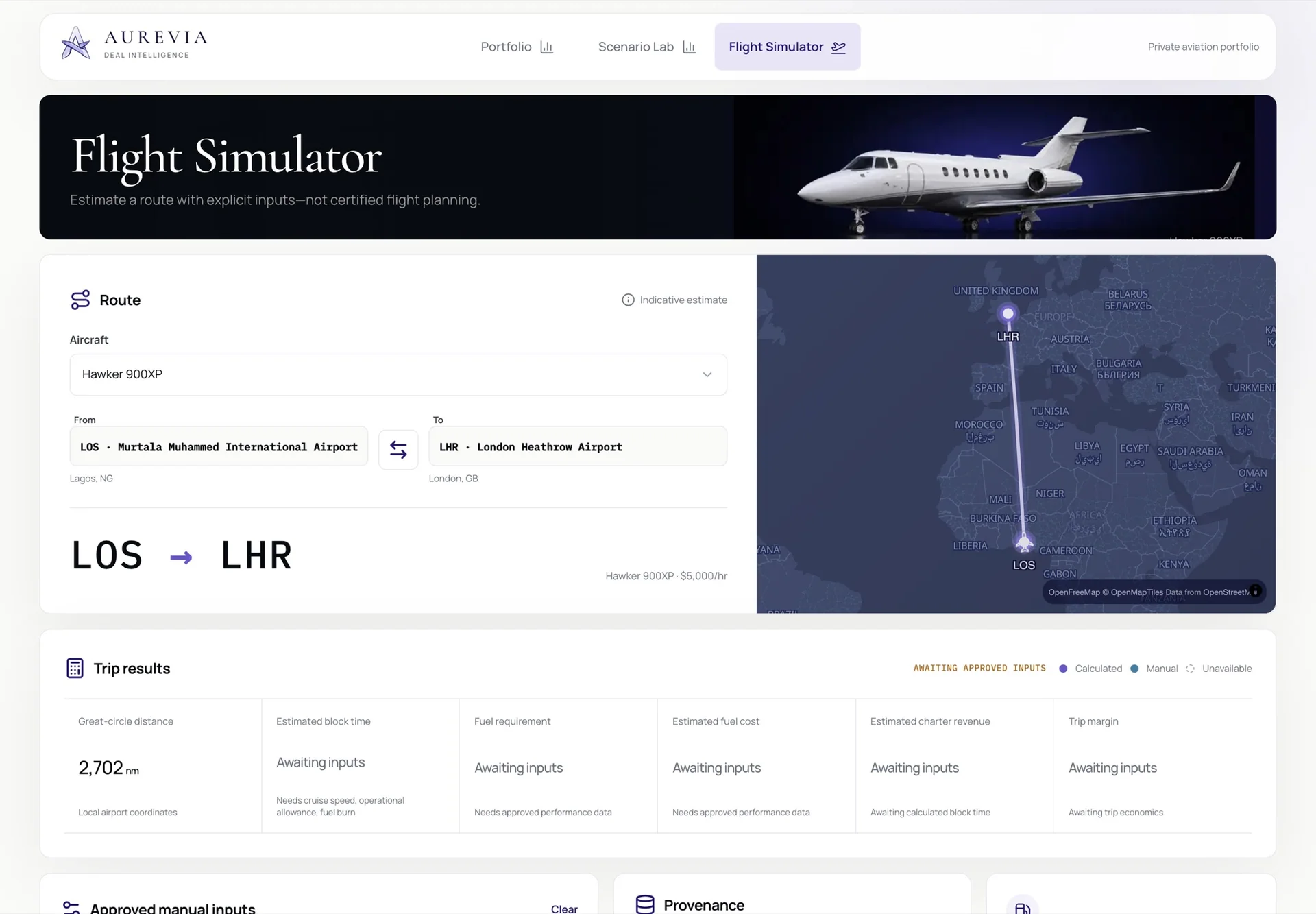
I built the whole application. Scenario Lab runs base, downside, stress and custom cases for one aircraft or the whole portfolio, and revenue, profit, return on investment and payback update as the inputs move. Flight Simulator prices a route between two airports from a local airport index and shows the great-circle line on a map. A Sources page traces every number on screen to where it came from.
03 / How it stays honest
Every value is tagged as a deal assumption, an aviation-team input, live market data, a user scenario or a calculated result, so the product never presents an assumption as a fact. The financial engine is deterministic and uses decimal arithmetic, with typed errors for impossible inputs. The flight tool will not compute fuel or trip economics until approved performance inputs exist, and it says plainly that it is not certified flight planning.
04 / Stack and checks
Next.js and TypeScript, Zod for validation, decimal.js for money, MapLibre for the route map and 3D aircraft models in the browser. The calculation engine has unit tests, and Playwright with axe covers accessibility. The aircraft shown are public models, and the figures on these screens are example inputs.